
Annual Report 2024/25 - Monitoring Progress
Foodbank Usage / Children Living in Low-Income Families / Fuel Poverty
Foodbank Usage
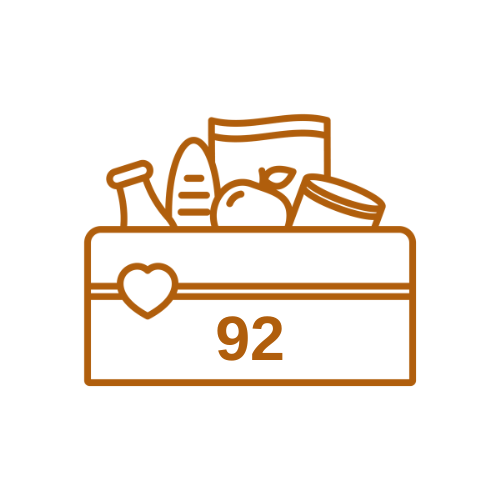 Foodbank usage tripled between 2018-19 and 2023-24, but 2024-25 saw a reduction in monthly parcels distributed. An average of 92 parcels were distributed per month in 2024-25, down from 137 the previous year. These supplies supported 1,541 people, with approximately 17% of those aged under 16. Some previous figures came from both the Shetland Foodbank and Anchor for Families. However, Anchor for Families, in the process of merging with the Shetland Family Centre, has not been distributing food parcels during the last year.
The Trussell Trust's mid-year report for Scotland (April-September 2024) shows that food bank need remains near record levels, though there was a 6% decrease in parcels distributed compared to 2023. This may reflect recent income boosts: eased inflation, a 6.7% benefits increase from April 2024, the unfreezing of Local Housing Allowance rates, and the winter payments made through the Islands Cost Crisis fund. While 92 parcels per month is a decrease from the previous year, it is still more than double the baseline and has not met the 2021 target of 34.
Children Living in Low-Income Families
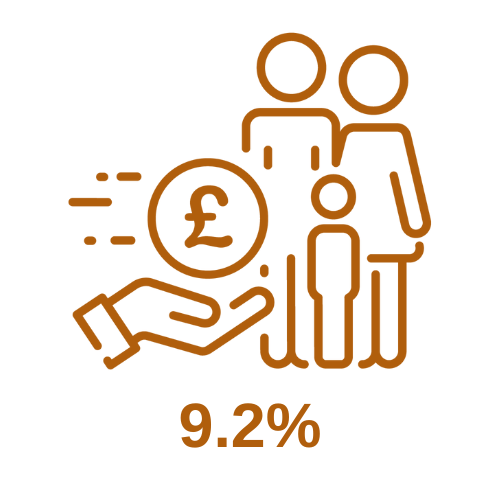 In 2023/24, Shetland had the third lowest level of children living in low-income families in Scotland, behind East Renfrewshire and East Dunbartonshire. 9.2% of children were living in low-income families, a 0.2% decrease from the previous year. Whilst lower than Scotland (16.3%) this is, however, higher than Shetland Partnership’s baseline (5.2%) and target levels (5% for 2021 and 3% for 2028). Additionally, the higher cost of living in remote and rural Scotland is not accounted for in these figures.
In general, statistics in Scotland and Shetland have shown a gradual increase in levels of child poverty since the early 2010s (Scottish Government), although they appear to be levelling off recently. Shetland levels have consistently been lower than Scotland as a whole.
 Other indicators such as Free School Meal uptake, Education Maintenance Allowance and School Clothing Grants can provide a more rounded picture of child poverty. The Local Child Poverty Action Report contains further details about how the partnership is monitoring and working to overcome child poverty in Shetland.
Please note that the statistics for this indicator have changed from what was previously reported. The trend remains similar, but the statistics published in March 2025 reflect some methodological updates. These updates have been applied to the back series and are available on both the Department for Work and Pensions website and Shetland Partnership website.
Fuel Poverty
 As reported previously, fuel poverty data at local authority level has not been available since 2019. The Scottish Household Condition Survey (2023) states that enforced changes for the 2021 survey have caused issues with the production of these estimates. The next estimates, based on 2022-2024 data, are expected in early 2026.
Trend analysis is difficult due to outdated data, but the Scottish Islands Data Overview (2023) shows island residents face higher fuel poverty. Many rural homes lack energy efficiency and gas grid access, relying on expensive heating fuels. The 2021 National Islands Plan survey found that nearly three quarters of island residents saw increased heating bills. Shetland's cold climate, poor insulation, and lack of cheap energy options worsen the situation.
 More recently, the Rural Scotland Data Dashboard shows that while rural areas have lower levels of relative poverty overall, low income households living in rural areas face particular challenges. There is widespread evidence that rural areas, and remote and island communities in particular, experience higher costs of living for some goods and services, such as weekly food costs and fuel.