
People who feel they want to be more involved in decision making
Trends and Analysis
| Year | 2016 | 2017 | 2018 | 2019 | 2021 | 2022 | 2023 | 2024 |
|---|---|---|---|---|---|---|---|---|
| Percentage of people who feel they want to be more involved in decision making | 41% | 42% | 35% | 20% | 45% | 37% | 30% | 30% |
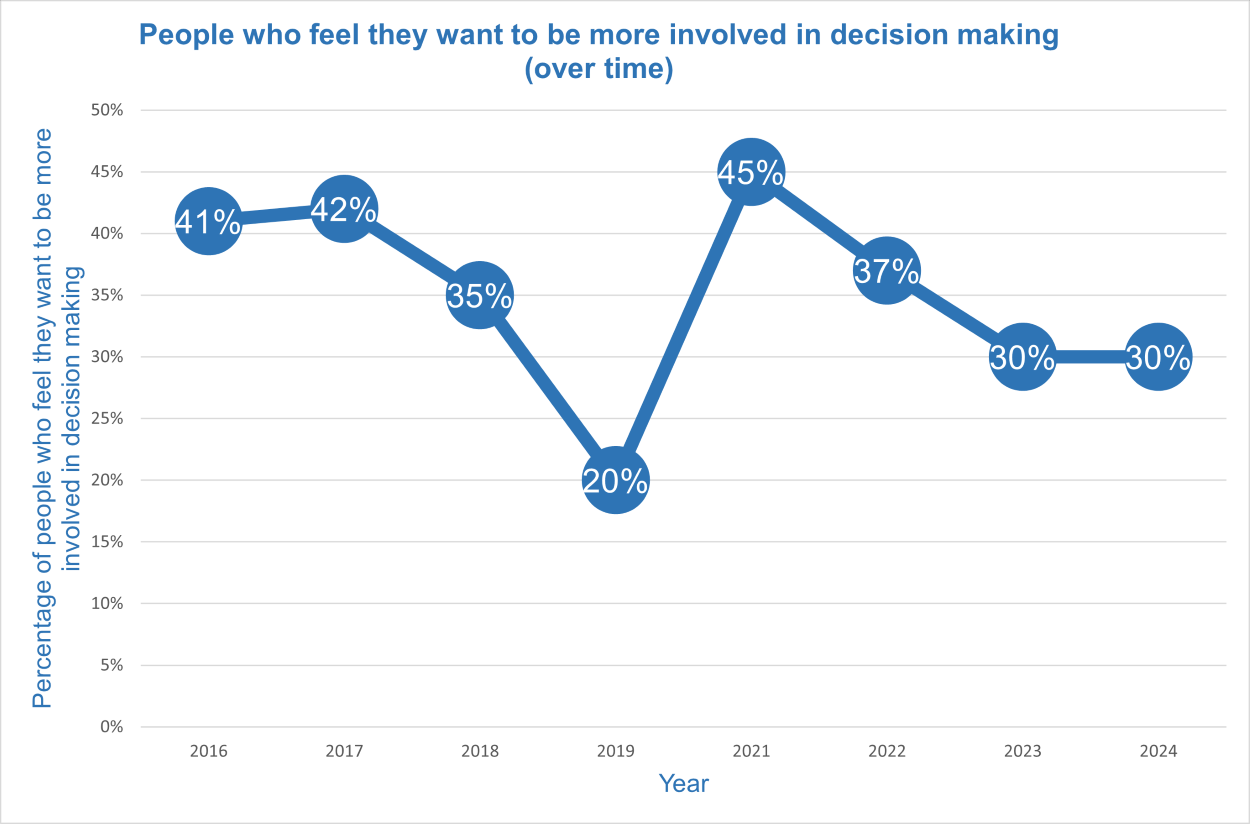
The graph and table show that there has been a fluctuation from the 2016 baseline of 41% to 30% in 2023 and 2024 with a low of 20% in 2019. Due to a smaller sample size in 2020, the data was not able to be broken down and published at local authority level.
The 2023 and 2024 percentage of 30% is a decrease from the 37% of 2022, a 15% decrease from 2021. This compares to a Scottish average of 33.5%. This could indicate there is more satisfaction with opportunities to get involved in decision-making, and the desire to be involved is more readily being met. Alternatively it could indicate that there is an apathy towards decision-making, and the community are disengaged from participation processes.
Greater involvement in decision-making links strongly to participation, which is a priority of the Shetland Partnership. The current rolling Delivery Plan for the Shetland Partnership is supported by a Place-Based Program of Change, which is about working alongside communities to achieve better solutions and outcomes. All improvement programmes within the Shetland Partnership Plan involve participation, and participation is a priority of the Community Learning and Development Plan 2021-2024.
Some examples of partners encouraging participation includes Shetland Islands Council and NHS Shetland having dedicated webpages with links to open consultations, feedback and complaint forms. These are all opportunities for people to have greater involvement in decisions affecting their local area.
Participatory budgeting is a way in which community members can have a say in deciding how, and where, local money is spent to deliver services and address local needs and issues. Shetland Islands Council has been delivering participatory budgeting projects with communities since 2010 as part of a wider approach to increasing participatory democracy (see examples of past projects here).
It is important that everybody’s voice is heard and those who want to participate can do so in a variety of ways. ‘Voices For’ was a Shetland Partnership Participation project which aimed to reduce inequalities in Shetland. The project recruited people from different parts of the community and paired them with people who influence and have responsibility for making decisions. The project meant that people experiencing inequality were able to share their knowledge directly with those with responsibility for Shetland’s public sector resources.
A piece of work is underway to produce a Participation Hub and Toolkit, to be published on the Shetland Partnership website. This Hub and Toolkit is for use by partners and communities, to help with planning and carrying out engagement activities.
The variation, over time, in people who feel they want to be more involved in decision making could correlate to opportunities available to become involved, some of which are outlined above. However, lower percentages could also be down to a lack of interest in being involved and it is important to continue focussing on participation and ensuring that people are closely involved in shaping the future of their communities.
Last updated: December 2024