
People who feel they can influence decisions affecting their local area
Trends and Analysis
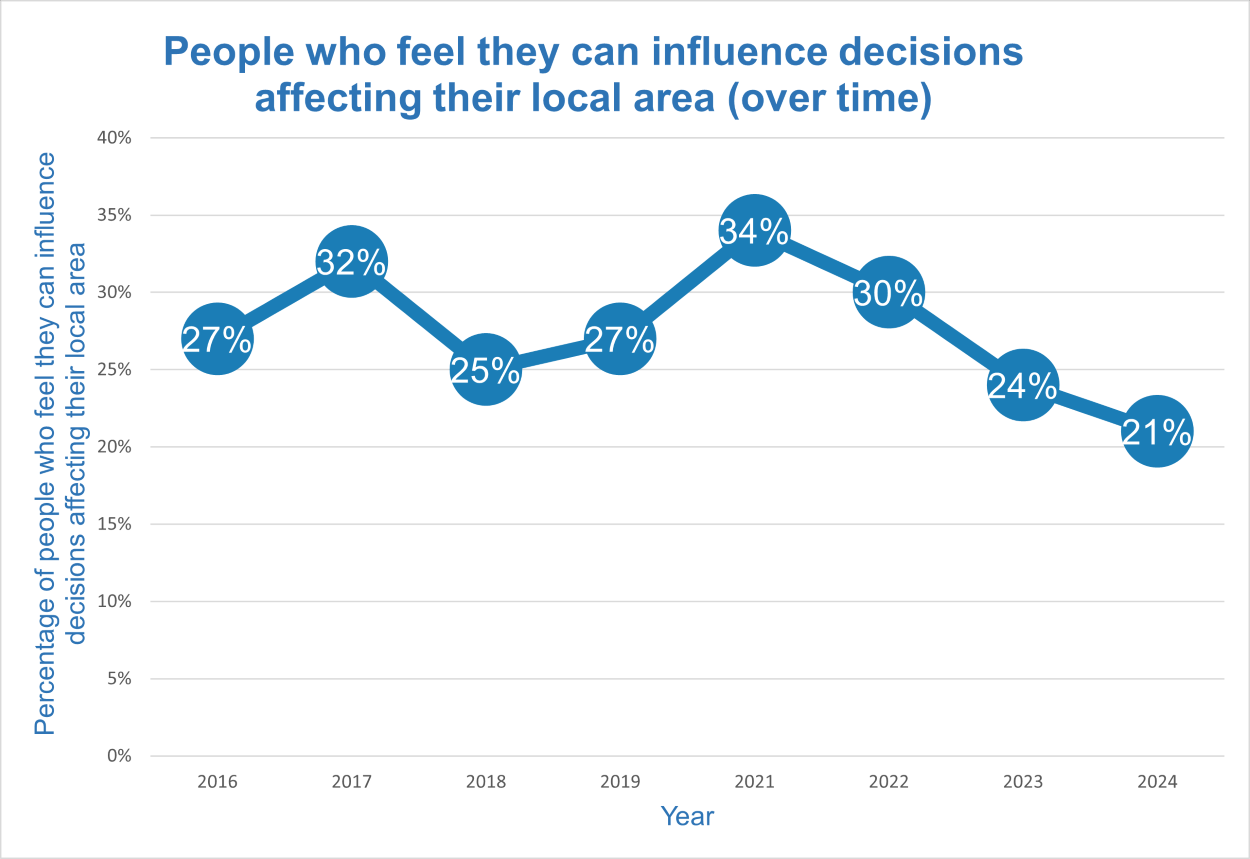
| Year | 2016 | 2017 | 2018 | 2019 | 2021 | 2022 | 2023 | 2024 |
|---|---|---|---|---|---|---|---|---|
| Percentage of people who feel they can influence decisions affecting their local area over time | 27% | 32% | 25% | 27% | 34% | 30% | 24% | 21% |
The graph and table above shows that 21% of people felt they could influence decisions affecting their local area in Shetland in 2024. This is the lowest level seen while monitoring this indicator from 2016, and is a 3% decrease from the previous year, and a 13% decrease from the 2021 peak.
Shetland has slipped to a ranking of 11 compared to other local authority areas of Scotland, having been amongst the highest rating. However, 21% is higher than the Scottish average of 19%.
As noted in the Source information, the results for 2021 were published as experimental statistics as this was done via telephone rather than face to face like prior years. Due to a small sample size in 2020, the date was not able to be broken down and published at local authority level.
People feeling they can influence decsions links strongly to participation, which is a priority of the Shetland Partnership. The current rolling Delivery Plan for the Shetland Partnership is supported by a Place-Based Program of Change, which is about working alongside communities to achieve better solutions and outcomes. All improvement programmes within the Shetland Partnership Plan involve participation, and participation is a priority of the Community Learning and Development Plan 2021-2024.
To increase the number of people who feel they can influence decisions in their local area, partners involve the community in how services are delivered and when designing programmes and strategies. This may be done through surveys, consultations, verbal feedback, steering groups or liaising with Community Councils, for example. The Participation Hub and Toolkit, has been launched on the Shetland Partnership website. This Hub and Toolkit is for use by partners and communities, to support the planning and delivery of engagement activities.
It includes resources on why and how to involve communities, national standards, methods of engagement, and examples of good practice. It also provides a link to each partners individual consultation web pages.
Last updated: May 2026