
Fuel Poverty
Trends and Analysis
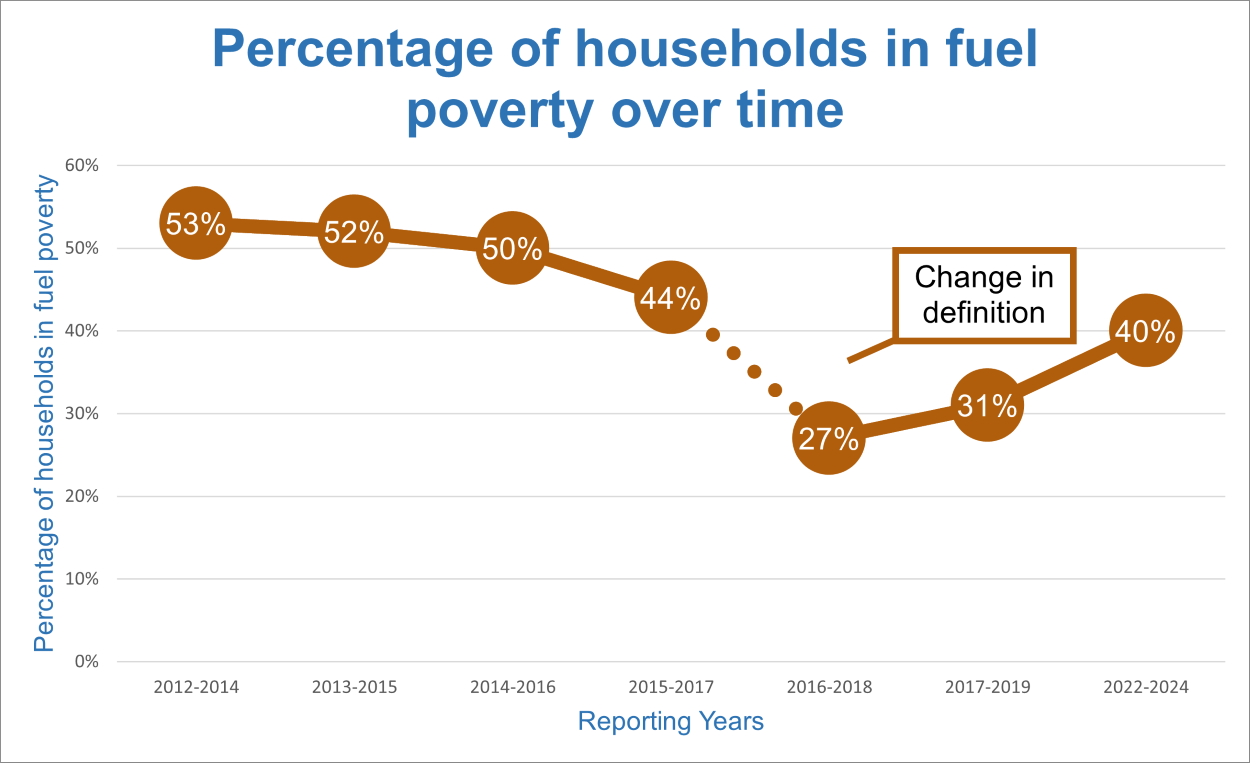
| Year | 2012-2014 | 2013-2015 | 2014-2016 | 2015-2017 | 2016-2018 | 2017-2019 | 2022-2024 |
|---|---|---|---|---|---|---|---|
| Percentage of households in fuel poverty | 53% | 52% | 50% | 44% | 27% | 31% | 40% |
Fuel poverty levels have again increased in Shetland since the new methodology used for the three-year average 2016/18. Levels for the three-year average 2022/24 are now 40%, an increase from 31% in 2017/19 and 27% in 2016/18.
However, the Scottish Islands Data Overview (2023) highlights that Scottish island residents are generally more likely to face fuel poverty than the average Scottish resident. The report refers to the Scottish House Condition Survey: Local Authority Analysis 2017-2019, which found that island and rural local authorities generally had the highest proportion of the least energy efficient dwellings; and that almost two-thirds of rural dwellings are not connected to the gas grid and therefore rely on more expensive heating fuel such as electricity and oil. Other specific rural drivers include a cold and wet climate, a lack of affordable housing and limited access to support services (Changeworks 2023).
The National Islands Plan Survey Final Report found that in 2021, nearly three quarters of Scottish island residents said that their heating bills had increased in the past year. While 71% of island residents overall agreed that they could afford to keep their home warm in the past year, the survey cited ‘Shetland Mainland’ as having significantly lower levels of agreement than other regions, with 63% agreeing they could afford to keep their home warm in the past year.
Shetland’s cooler climate, poor insulation levels and generally poorer energy efficiency in homes compound the effect of energy price rises on our communities.
On top of this, the lack of availability of the cheapest energy options adds further difficulties for people living in Shetland, as does the rise in food costs. For example, Shetland households are not able to access mains gas.
Last updated: May 2026