
Community Council Seats Contested
Trends and Analysis
| Year | 2018 | 2019 By-Election | 2022 | 2025 |
|---|---|---|---|---|
| Available seats | 163 | 43 | 163 | 163 |
| Total number of Community Councils participating | 18 | 15 | 18 | 18 |
| Nominations received | 120 | 32 | 125 | 114 |
| Vacant Seats | 43 | 16 | 38 | 49 |
| Return rate | 73.6% | 74.4% | 76.7% | 69.9% |
| Contested seats | 0 | 9 | 0 | 0 |
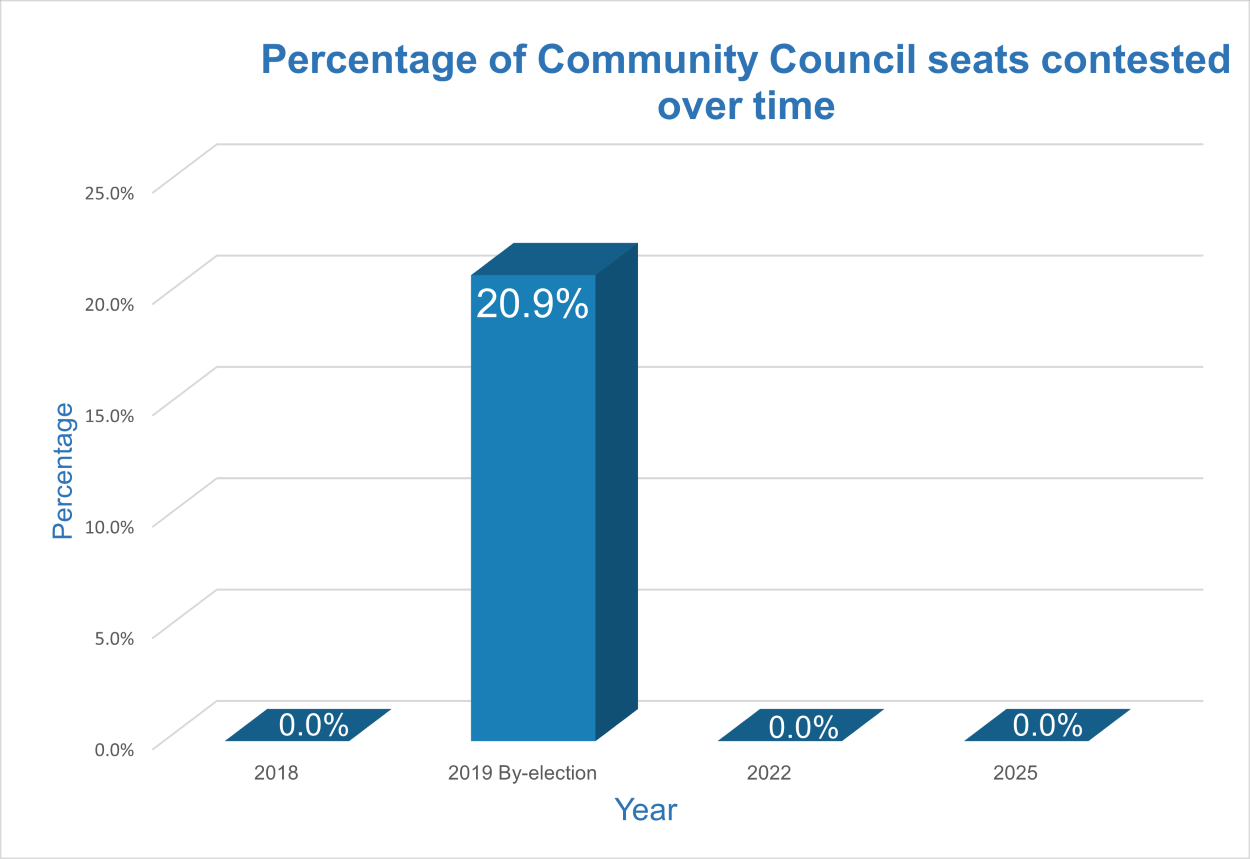
| Percentage of total seats contested | 0.0% | 20.9% | 0.0% | 0.0% |
| Contested Councils | 10 | 4 | 0 | 0 |
| Percentage of Councils contested | 0.0% | 26.7% | 0.0% | 0.0% |
In 2018, there were 163 Community Council seats available. A total of 120 nominations were received, giving a return rate of 74%. None of the seats were contested, and 43 seats remained vacant.
Due to the number of vacancies, a by-election was held in 2019. A total of 32 nominations were received for the 43 vacant seats, again representing a return rate of 74%. Seats were available in 15 Community Councils, with contests taking place in 4 of them. Overall, 9 of the 43 available seats (21%) were contested. Not all vacancies were filled, and 16 seats remained vacant following the by-election.
The proportion of contested seats increased from 0% in the 2018 election to 21% in the 2019 by-election, exceeding the 2021 target of 10%. However, this figure should be interpreted with caution, as the by-election involved a smaller number of seats than the full election.
Looking at Community Councils rather than individual seats, 27% of participating Community Councils saw contested seats in the by-election (4 out of 15). When all 18 Community Councils are included, this falls to 22%.
In November 2022, 125 nominations were received for the 163 available seats, giving a return rate of 77%. No seats were contested, and 38 seats remained vacant.
In November 2025, 114 nominations were received for the 163 available seats, a return rate of 70%. Again, no seats were contested, leaving 49 vacant seats.
Overall, nomination rates have remained relatively stable since the 2018 baseline of 74%, fluctuating between 70% and 77%. However, levels of contested seats have remained very low, with no contested seats in either the 2018, 2022 or 2025 elections. The only contested seats were recorded during the 2019 by-election, when 21% of available seats were contested.
In March 2025, Shetland Islands Council completed a review of its Scheme for the Establishment of Community Councils and approved a new Scheme, which took immediate effect. The review covered a range of matters including the number of Community Councils, Community Council areas and boundaries, election rules, the roles and responsibilities of community councillors, Community Council funding and other governance requirements.
While nomination rates have remained broadly stable over time, increasing participation in Community Councils remains a priority. The Encouraging Participation in Local Democracy case study highlights the partnership approach taken to promote the 2025 Community Council elections and support wider community involvement in local decision-making.
Last updated: October 2026