
Children who are not a healthy weight in Primary 1
Trends and Analysis
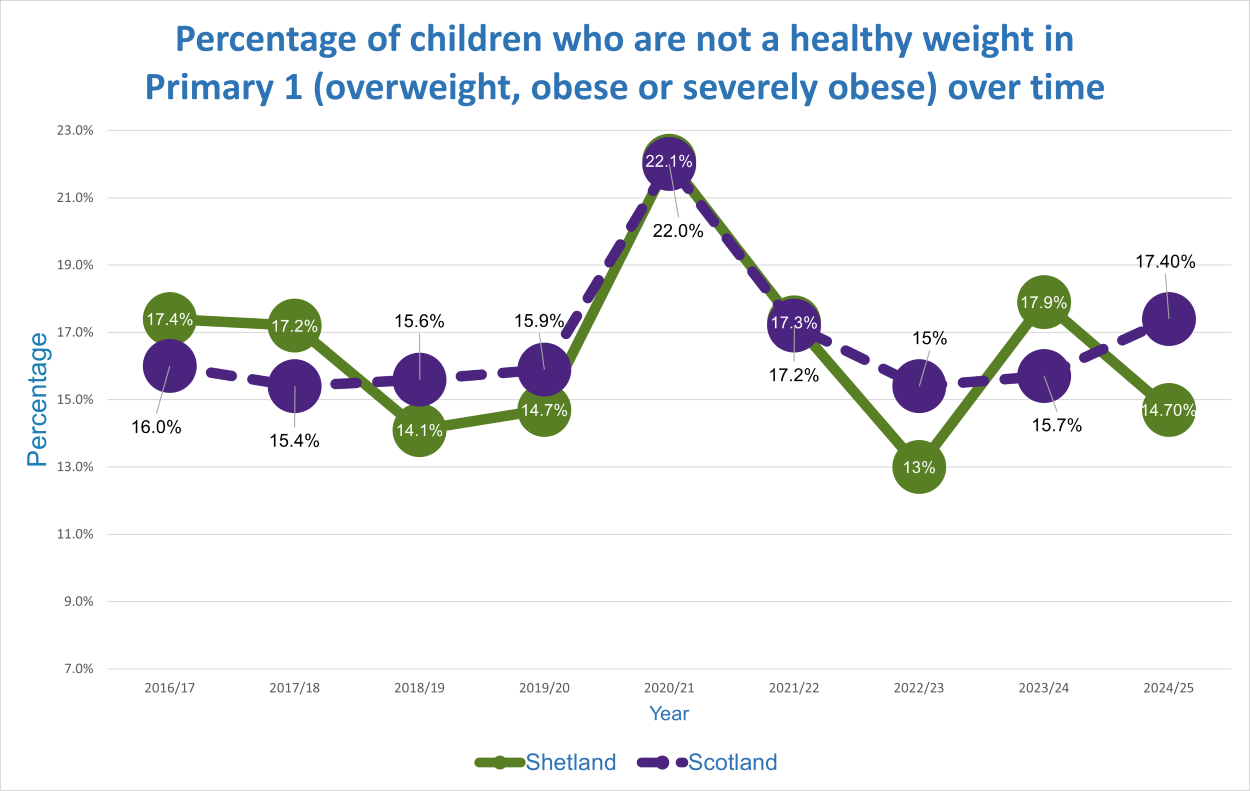
| Year | Percentage of chidren who are not a healthy weight in Primary 1 (overweight, obese or severely obese) in Shetland | Percentage of chidren who are not a healthy weight in Primary 1 (overweight, obese or severely obese) in Scotland |
|---|---|---|
| 2016/17 | 17.4% | 16% |
| 2017/18 | 17.2% | 15.4% |
| 2018/19 | 14.1% | 15.6% |
| 2019/20 | 14.7% | 15.9% |
| 2020/21 | 22.1% | 22% |
| 2021/22 | 17.3% | 17.2% |
| 2022/23 | 13% | 15% |
| 2023/24 | 17.9% | 15.7% |
| 2024/25 | 14.7% | 17.4% |
The above graph and table shows that the percentage of children who are not a healthy weight in Primary 1 has fluctuated between 2016/17 and 2024/25 for both Shetland and Scotland. In general, data is is demonstrating a downward trend. In Scotland, the average was 17.4%, and showed a slight increase, having also been a downward trend.
The Primary 1 Body Mass Index (BMI) statistics Scotland School year 2023 to 2024 report mentions that the proportion of children classified as healthy weight in Scotland ranged from 78.9% in NHS Lothian to 67.9% in NHS Orkney. 72.3% of children in Shetland had a healthy weight*.
The trend in England over time has been similar to that seen in Scotland, with a substantial increase in the proportion of children at risk of overweight/obesity during the years most affected by the COVID-19 pandemic, and then a subsequent reduction. There is also some international evidence from the USA which suggests that children gained weight more rapidly over the pandemic period.
A number of factors have been highlighted that are possibly linked to an increase in children’s BMI during the pandemic period. These include an increase in food security, a reduction in access to healthy food in school and childcare settings, a reduction in physical activity due to restrictions and a loss of routine daily activity such as walking to nursery, and stress and anxiety among children and families (Public Health Scotland 2022).
Public Health Scotland acknowledges some limitations of the data, with difficulty in carrying out reviews during the COVID-19 pandemic due to school closures and coverage varying between NHS boards. The sample size was lower than usual, however, the limitation is most likely to be reflected in difficulty estimating the true scale of change rather than the fact there is a difference.
Public Health Scotland noted that boys in Primary 1 were slightly less likely than girls to have a healthy weight. As well as this, children living in more deprived areas were less likely to have a healthy weight than children living in the least deprived areas.
Over the past 20 years in Scotland, the proportion of children at risk of overweight or obesity has increased in the most deprived areas and decreased in the least deprived areas. In 2020/21, the proportion of children at risk of overweight and obesity increased across all deprivation levels. This unfair difference in health between different groups of people based on circumstances beyond their control is a health inequality. There are high levels of socioeconomic inequality in child healthy weight, and these have increased over time.
Public Health Scotland (2024) highlights that the opportunities all children have to be active in daily life, and the availability of healthy foods, has an influence on health.
To reduce the overall proportion of children in Scotland with unhealthy weight and to reduce inequalities in unhealthy weight needs comprehensive and sustained action. Effective interventions are available, and include actions to:
- Reduce maternal overweight and obesity
- Promote breastfeeding
- Support children’s access to appropriate quantities of nutritious food in the home, early learning and childcare and school settings
- Promote opportunities for physical activity and reduce sedentary time
- Promote adequate sleep
Interventions to influence the wider food environment such as food advertising, labelling and price are important. Interventions that support individual children and families also have a role.
As well as preventative action it is important that children who have unhealthy weight have access to effective, appropriate support to improve their health in childhood and reduce their risk of becoming obese adults.
For more information on Scottish child healthy weight policies see the Public Health Scotland report for Body Mass Index of Primary 1 Children in Scotland School Year 2023/24.
NHS Shetland is working alongside partners to meet new standards for children’s weight management services. This work is organised under three “tiers”:
- Tier 1: Universal Prevention
- Tier 2: Targeted lifestyle weight management interventions
- Tier 3: Specialist services
Tier 1 is a broad, partnership approach and locally is founded in the principles of the HENRY approach. The approach is designed to be used by anyone working with families or children in their day-to-day work and includes such topics as:
- The five elements of a healthy start- parenting, lifestyle habits, nutrition, physical activity and emotional wellbeing.
- Working in partnership with families- a strength based, solution focused approach to supporting behaviour change.
- Emotional dimensions of change- links between behaviours, feelings and needs, and the power of empathy as a catalyst for change.
- National guidance on healthy nutrition and physical activity for babies and children of all ages.
Tier 2 and 3 interventions are led by the NHS Shetland Dietetic Department, delivery and improvement of these in line with national standards is underway.
*This is using the epidemiological category as opposed to clinical. Epidemiological thresholds are used for population health monitoring purposes and refer to those at risk within the population.
Last updated: May 2026