
Children living in low income families
Trends and Analysis
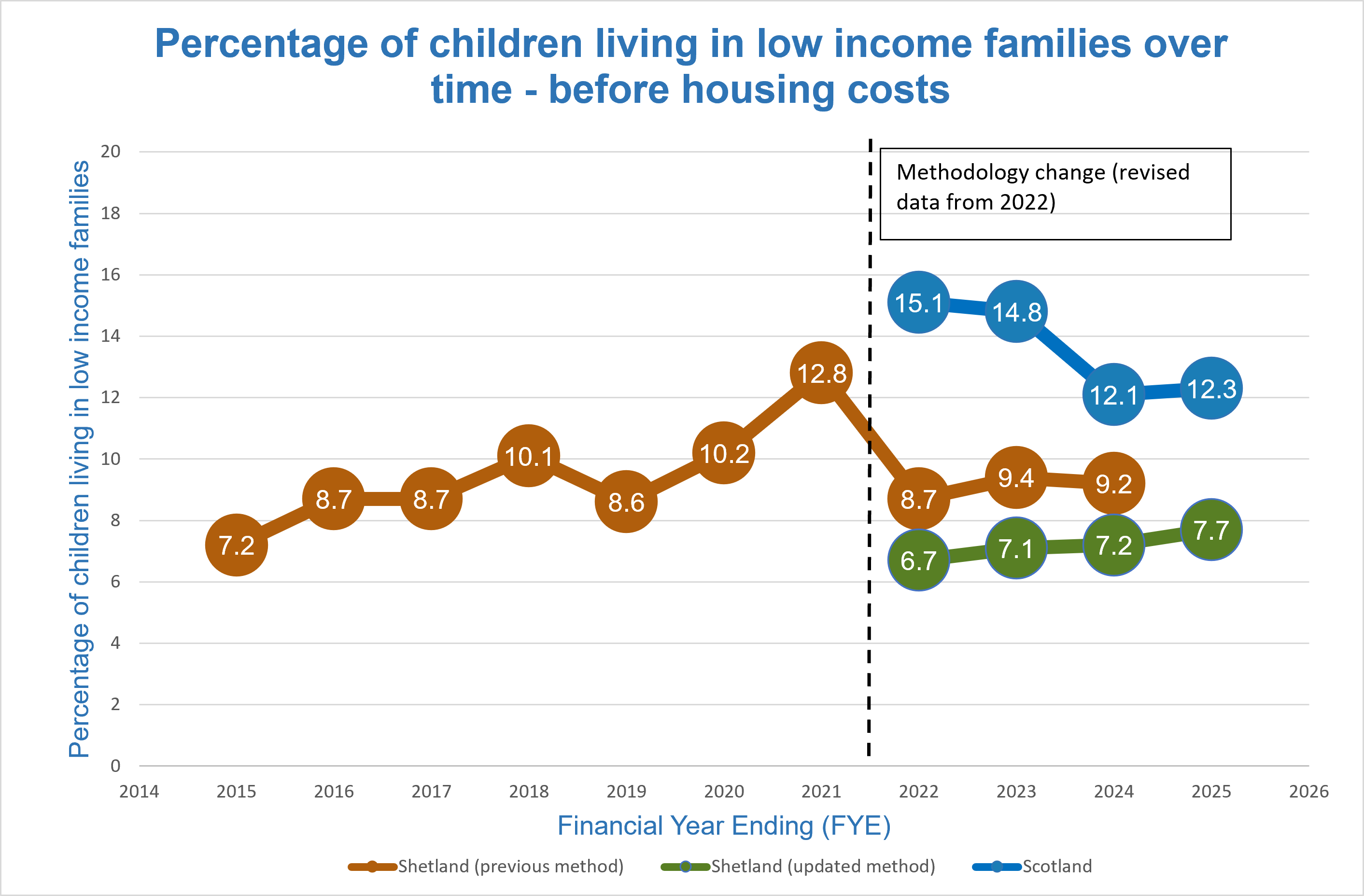
| Year | 2015 | 2016 | 2017 | 2018 | 2019 | 2020 | 2021 | 2022 | 2023 | 2024 |
|---|---|---|---|---|---|---|---|---|---|---|
| Percentage Shetland | 7.2 | 8.7 | 8.7 | 10.1 | 8.6 | 10.2 | 12.8 | 8.7 | 9.4 | 9.2 |
| Percentage Scotland | 15.4 | 16.6 | 16.4 | 18.3 | 16.8 | 19.5 | 16.8 | 16.9 | 17.8 | 16.3 |
Note on statistics
Please note that these statistics have changed from what was previously published and reported. However, the trend remains similar. The reason for this change is that the statistics published in March 2025 reflect some methodological updates. This includes the incorporation of Scottish Child Payment Data, which began in February 2021. Additionally, previous publications of these figures were calibrated to the 3-year regional HBAI totals, whereas they are now calibrated to 1-year totals. Statistics published in 2025 reflect revisions to previously published statistics across the back series and are presented here. More information on this can be found on the Department for Work and Pensions website.
Trend and analysis
Data for Children Living in Low Income Families relates to Financial Year End (FYE). Where a year is referenced in the below analysis it should be taken as FYE, for example 2024 should be treated as Financial Year Ending 2024.
The above graph and table show that child poverty levels rose for both Shetland and Scotland between 2015 and 2018. There was a slight drop in 2019, rise in 2020, and in 2021, the percentage of children living in poverty decreased for Scotland as a whole, yet, increased in Shetland. In 2022 child poverty rates in Shetland fell and increased slightly in Scotland. In 2023, there was a slight rise in children living in poverty for both Shetland and Scotland to 9.4% and 17.8% respectively. This declined to 9.2% and 16.3% in 2024.
The 2021 trend, where levels rose in Shetland and decreased in Scotland, may be explained by the following:
- There was an uplift in the value of Universal Credit in 2020-21. This meant that for families already on Universal Credit, many were moved out of what is defined as low income. Those households claiming Universal Credit were likely to be more concentrated in urban areas, accounting for the decrease in levels of child poverty in many of these areas.
- In Shetland, where costs are high and employment relatively buoyant, most households have work, if only small amounts, just to get by. This means that most poverty is "working poverty"
- People's incomes may have been hit by loss of earnings due to the pandemic, especially those in casual employment and those in hospitality and retail.
- Opportunities to work in 2020/21 may have been lost which would have reduced incomes for some families and led to an increase in uptake of benefits.
- The increase in other areas and the reduction in Shetland in 2021/22 may be explained by a reversal of the trends caused by pandemic impacts.
In 2023/24, Shetland had the third lowest level of children living in low-income families in Scotland, behind East Renfrewshire and East Dunbartonshire. 9.2% of children living in low-income families is, however, higher than Shetland Partnership’s baseline and target. In addition, the higher cost of living in remote and rural Scotland is not taken into account with these figures. The cost of living in Shetland is 20-65% higher than the UK mainland (Minimum Income Standard 2016). There is recognition of a need to redo this research, in order to understand the impacts of Brexit, the pandemic and the cost of living crisis on Shetland’s cost of living, relative to the UK.
In general, the statistics in Scotland and Shetland have shown a gradual increase in levels of child poverty since the early 2010s (Scottish Government), although appear to be levelling off recently. Shetland levels have consistently been lower than Scotland as a whole.
Child Poverty Action Group highlight that poverty rarely has a single cause and that in the past, child poverty levels in the UK have been significantly lower than they are today. A range of factors including: rising living costs, low pay, lack of work and inadequate social security benefits together, mean that some people do not have enough resources.
Children in low income families tells part of the picture when looking at child poverty. Other indicators such as Free School Meal uptake, Education Maintenance Allowance and School Clothing Grants can be helpful to get a more rounded picture.
The data for child poverty after housing costs for 2023/24 is now available, the data has been published here: Local Child Poverty Statistics - End Child Poverty. This data shows that Shetland had the second lowest child poverty rate (after housing costs) across all the Scottish council areas in 2023/24. Since 2014/15 the Shetland child poverty rate has increased overall by 1.2 percentage points (from 13.3% to 14.5%). Of the 10 council areas with the lowest rates, four saw increases in this time period: Aberdeen with a marginal increase of 0.3 percentage points, Stirling also with a marginal increase of 0.9 percentage points, Shetland with a 1.2 percentage point increase, and then Na h-Eileanan Siar with a larger increase of 2.2 percentage points. The Shetland figure for 2023/24 does represent a 3-year trend of reducing year on year, and is also at its lowest rate since 2018/19.
The Local Child Poverty Action Report contains further detail about how the partnership is monitoring and working to overcome child poverty in Shetland.
Last updated: November 2025
