
Working Together to Improve Stroke Care in Shetland
Improving coordination across the stroke pathway

When someone experiences a stroke, every minute matters. Rapid assessment, imaging and treatment can reduce disability and improve recovery. During 2025/26, the Scottish Ambulance Service (SAS) and NHS Shetland worked together to review and refresh Shetland's acute stroke pathway, considering the whole patient journey from the initial 999 call through ambulance care, hospital assessment, imaging and treatment.
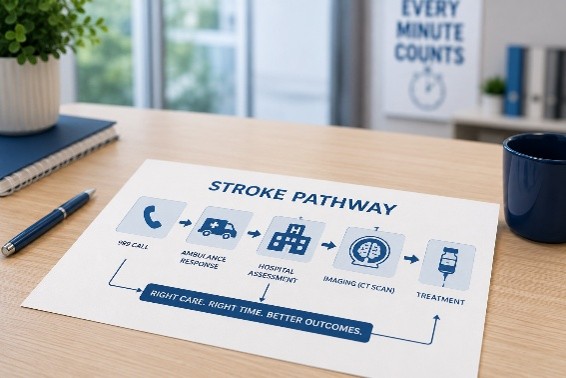
Stroke is a leading cause of death and disability in Scotland. Although local performance was strong in several areas, partners identified opportunities to reduce avoidable delays, improve consistency and ensure that each part of the pathway worked as one joined-up system.
Rather than reviewing procedures separately, SAS and NHS Shetland adopted a collaborative, whole-system approach. Staff jointly mapped the journey from the initial 999 call and ambulance response through hospital arrival, imaging and treatment. The refreshed pathway combined national learning with Shetland's circumstances, including the different setup at the Gilbert Bain Hospital, aiming to get patients treatment within the hour on arrival to hospital.
A key feature was the use of in-situ simulation. Ambulance crews, doctors, nurses, allied health professionals and support staff tested the pathway in the real clinical environment, using realistic scenarios to identify potential safety issues and inefficiencies before they could affect patients. Immediate feedback enabled different professions and grades to refine processes and communication together.
The review also drew on SAS data covering 1 January 2022 to 31 December 2024. Shetland's average ambulance on-scene time for suspected stroke patients was 22 minutes - substantially better than the national average of 32 minutes, although just above the SAS target of 20 minutes or less. The data showed frequent pre-alert notifications and generally consistent use of the FAST assessment tool, while also highlighting the need to improve recording of stroke-onset time and ensure every FAST component is consistently assessed and documented.
Together, the simulation and data review informed a refreshed pathway that was practical, evidence-based and shaped by the people using it. The work strengthened shared ownership across ambulance and hospital teams and translated identified gaps into a clear action plan: continued joint simulations and pathway refinement, regular training and reminders, and audit and feedback on FAST documentation.
"This work is already having a positive impact on patient care in Shetland. Through close collaboration between NHS Shetland and the Scottish Ambulance Service, we have reviewed and strengthened the entire stroke pathway to help ensure patients receive the right treatment at the right time. Most importantly, this partnership approach is helping to improve outcomes for patients and their families when every minute matters."
Daniel Mainland, Clinical Team Leader, Lerwick Community Fire and Ambulance Station
The project demonstrates the value of combining local performance evidence with collaborative testing. By examining the whole patient journey together rather than working in organisational silos, partners could protect existing strengths, focus improvement on specific delays and recording gaps, and establish a cycle of continued review. This supports more coordinated decisions and the best possible chance of timely treatment for people experiencing stroke in Shetland.
Contribution to the Shetland Partnership
- People: Supporting timely, coordinated stroke care and improving the prospects of effective treatment and recovery.
- Participation: Bringing together ambulance clinicians, hospital staff and multidisciplinary teams to jointly design, test and refine the pathway.
- Place: Strengthening island-wide stroke care through a pathway designed for Shetland's circumstances while aligned with national standards.